
C-1. Where to begin as a company?
Section outline
-
-
Aaron Shum (PUMA) provides a step-by-step guide for implementing chemicals traceability based on the approach used by PUMA and their learning so far. This actionable input helps companies getting started and navigating the process.
Access to the presentation slides here.
Access to the video script here.
To learn more about what the company is doing for Chemic PUMA Chemical Standards Handbook 2023
-
The status-quo analysis from Milena Amaral (NEOVILI) provides a comprehensive overview of the current practices and challenges regarding chemicals traceability both in textile apparel and carpets.
Access to the full PDF report which allows for a deep-dive into the data.
Access to the video script.
-
The Theory of Change presented in this document is a co-creative result of the ECHT project consortium.
2025
Source: https://knowledge.trace-chemicals.eu/mod/resource/view.php?id=367
-
"Empowered by Transparency" is the progressive scenario story derived from a six-month co-creative process with actors from textile industry, NGOs, academic and public sector. The story illustrates the status-quo in 2040 and shows to what extent and how traceability of chemicals can be set in place, who needs to be involved and what the specific benefits including business models might be. This story was chosen to be the goal scenario for the ECHT project unanimously by all project partners involved in the process. It also represents that impact aimed for in the theory of change.
-
"No P(l)ace for Trace" is the conservative and less-inspiring scenario story derived from a six-month co-creative process with actors from textile industry, NGOs, academic and public sector. The story illustrates a status-quo in 2040 where things mainly stated the same and no substantial progress was made regarding chemicals traceability. This story was explicitely dismissed as goal scenario for the ECHT project unanomously by all project partners involved in the process.
-
This list indicates all 16 influencing factors identified during the scenario process of the ECHT project. They ware found to be the key leverage points for advancing or hindering chemicals traceability in global textile value chains.
Source: Glossary influencing factors
-
-
-
Implementing chemical traceability along global value chains is a complex and iterative process that requires a holistic understanding of current processes and goals in one’s organisation and the supply chain. To quickly cover all these topics in an easy-to-access manner, the “Chemicals Traceability Canvas for Textiles” proposes a structured path through the key stages and fields of implementing chemical traceability along textile value chains.
Access to the chemicals traceability canvas
-
This training schemes concepts outlines the overall structure and content of a capacity building workshop series targeted at SMEs in the textile apparel value chains. It makes use of the tools and approaches developed in the ECHT project.
Access to the Concept for Training Schemes.
-
"Trace-It" is a simulation game that allows players to step into the shoes of departments of organisations aiming to implement chemicals traceability.
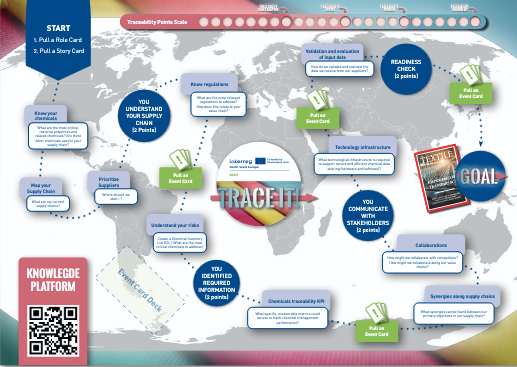
Throughout the game play, players will be confronted with various challenges that need to be solved as a team. The game can be played in workshops with representatives from different organisations (incl. industry, NGO and public sector) or inside one company.
Access to the Manual of the Trace-IT Game
Access to the Trace-IT Game materials
-
The present report proposes a method for the definition and tracking of substances of concern in products (as defined in Article 2(27) of the ESPR) as well as for the assessment and preparation of potential restriction measures for substances impacting the product aspects listed in Article 5(1) of the ESPR. The method informs the setting of performance requirements and information requirements, when relevant for the product under study. The intended audience for this report is primarily members of teams who will be undertaking Preparatory Studies for ESPR product groups, including from the European Commission, as well as stakeholders.
Rôles: #manufacturer, #economic operator, #distributor
November 2025
Source: https://publications.jrc.ec.europa.eu/repository/handle/JRC143683
-
The ZDHC Commodity Chemical Guide V1.0 has been developed to provide a holistic approach for manufacturers of textile, apparel, leather, and footwear products to responsibly manage their commodity chemicals.
Roles: #distributor, #manufacturer, #economic operator
May 2024
Source: https://downloads.roadmaptozero.com/input/commodity-chemicals-guide
-
-
-
This 32-question document is the most comprehensive official guidance available to date on how the DPP will work under the Ecodesign for Sustainable Products Regulation (ESPR) — Regulation (EU) 2024/1781. The FAQ targets every stakeholder involved in the DPP ecosystem. Manufacturers and importers will find clarity on their obligations to create, register and maintain passports before placing products on the EU market. SMEs can understand the specific support mechanisms foreseen under Article 22 of the ESPR, including free digital tools and mandatory national one-stop shops. Distributors and online marketplaces learn when and how they become responsible for DPP accessibility. Consumers get a clear picture of their rights to access product information — free of charge, anonymously, without a smartphone if needed. Repairers and recyclers discover how the DPP will unlock technical data that makes circular business models more viable. Customs and market surveillance authorities understand how the central DPP Registry will enable automated border checks and targeted enforcement.
May 2026
-
The DPP Registry acts as the indexing service for all Digital Product Passports of products placed on the EU market. The Registry will function as a secure database that stores the unique identifiers, registration data, and high-level metadata for each product, rather than the full detailed product information contained in the DPP itself. Depending on the applicable delegated acts or other Union legislation, additional information may also be required to be stored in the Registry (https://single-market-economy.ec.europa.eu/single-market/digital-product-passport/dpp-registry_en).
This guide is intended to guide Economic Operators in using the DPP Registry. This document provides relevant information and instructions regarding the organistion, enrollment, verification and registration of DPPs.September 2026
-
Featured in this book is the 'Why' and 'What' of DPP, and for the first time, presents fashion brands and retailers with a proposal and guidelines for the 'How'. As the 'responsible economic operators' for complying with DPP, brands and retailers can, and should, begin preparing for DPP now, and this book is their essential guide.
Roles: #manufacturer, #distributor, #economic operator, #DPP service provider, #policymakers
Source: https://trustrace.com/hubfs/TrusTrace-Unlocking-DPP.pdf
-
Gain a deeper perspective on how to implement DPPs. Learn from experts who have piloted DPPs on real-life garments in the first textile-specific end-to-end case study for how to implement DPPs.
Roles: #distributor, #manufacturer, #economic operator
-
This report presents a practical, step-by-step methodology to define a proposal of which data should be included in Digital Product Passports (DPPs) under the Ecodesign for Sustainable Products Regulation (ESPR), and why it should be included. It complements and extends existing ESPR methodological work by focusing on the semantic definition and prioritisation of DPP information requirements within the specific context of the DPP, while also systematically investigating current industry data collection and data-sharing practices across product value chains. The methodology translates policy objectives and use cases into structured data needs, distinguishing essential, strongly recommended and voluntary elements through a transparent value–effort and feasibility assessment grounded in real-world practices.
Roles: #DPP service provider
March 2026
Source: https://publications.jrc.ec.europa.eu/repository/handle/JRC145830
-
This preparatory report from the Joint Research Centre outlines proposed data content for the future delegated act on textile apparel under the Ecodesign for Sustainable Products Regulation (ESPR). This comprehensive study shifts the apparel industry away from self-regulated, fragmented sustainability claims and moves it into a highly standardized, mandatory digital ecosystem. It details mandatory data elements, how data will be structured, and how the Digital Product Passport (DPP) will function as a regulatory gateway to the EU market.
May 2026
-
Cirpass2 presents a proposal for a reference architecture for the EU DPP system. The proposal comes in two versions: 1) One proposal for the reference architecture of the DPP system; 2) One proposal for the simplest and lowest cost implementation of the EU DPP system, based only on well-established web technologies and services. Furthermore, a video presentation on the proposal is available.
Roles: #manufacturer, #DPP service provider, #blockchain integrators, #distributor, #customer, #dealer
May 2025
Sources:
D4.1 Reference architecture: https://zenodo.org/records/15467720
The simplest DPP System Proposal – A thought experiment: https://zenodo.org/records/15367064
Video "CIRPASS-2 DPP system architecture (presentation by Huib van Nieuwenhuijze, TNO - October 3, 2025)": -
This paper provides an analysis of the implementation of mandatory Digital Product Passports (DPPs) for apparel at three potential levels of granularity of DPP information: model, batch, and item. This document was prepared and reviewed collaboratively by the partners of the CIRPASS-2 consortium, with the goal of informing the ongoing discussion in the ESPR Ecodesign Forum on a delegated act for textiles (including apparel).
November 2025
Roles: #manufacturer, #DPP service provider, #distributor, #economic operator
-
-
-
GS1 is a company providng barcode to industry of all sorts. Their standards are the most widely used system of standards in the world. The objective of the GS1 Global Traceability Standard (GTS) is to assist organisations and industries in the design and implementation of traceability systems based on the GS1 system of standards. At a strategic level, this standard aims to provide key insights and knowledge for organisations or industries that are developing long-term traceability goals.
Roles: #manufacturer, #distributor, #economic operator
-
OEKO-TEX® standards enable everyone to make responsible decisions and protect natural resources. Driven by sustainability and a dedication to transparency, our work is grounded in proven science. OEKO-TEX® STANDARD 100 is a label for textiles tested for harmful substances. It sets the benchmark for textile safety, from yarn to finished product. Every item bearing the STANDARD 100 label is certified as having passed safety tests for the presence of harmful substances.
Roles: #manufacturer, #distributor, #economic operator, #policymakers
-
OEKO-TEX® STANDARD 100 is a label for textiles tested for harmful substances. It sets the benchmark for textile safety, from yarn to finished product. Every item bearing the STANDARD 100 label is certified as having passed safety tests for the presence of harmful substances.
Roles: #Authorised representative, #Dealer, #Distributor, #Importer, #Manufacturer
March 2025
Sources:
- Standard OEKO-TEX - Edition 01.2026: https://www.oeko-tex.com/fileadmin/user_upload/Marketing_Materialien/STANDARD_100/Standard/OEKO-TEX_STANDARD100_Standard_EN.pdf
- Application for Active Chemical Products: Active Chemical Products/Acceptance in the OEKO‑TEX® list: https://www.oeko-tex.com/fileadmin/user_upload/Marketing_Materialien/ACP/OEKO-TEX_Application_for_Active_Chemical_Products_EN.pdf
- Standard OEKO-TEX - Edition 01.2026: https://www.oeko-tex.com/fileadmin/user_upload/Marketing_Materialien/STANDARD_100/Standard/OEKO-TEX_STANDARD100_Standard_EN.pdf
-
This document updates the global standard for sustainable cotton production, strengthening focus on regenerative agriculture, climate change, and social impacts. It covers six principles, including soil health, water stewardship, and decent work, aiming to drive continuous improvement at the farm level.
Roles: #Authorised representative, #Dealer, #Distributor, #Importer, #Manufacturer
March 2023
Source: Version 3.0: https://bettercotton.org/wp-content/uploads/2023/04/Better-Cotton-PC-v.3.0.pdf
-
In this video (from the ECHT Traceability conference, on 19.11.2025), Laetitia Georgel from Terra Matters illustrates the functionality and use case of Product Circularity Data Sheets (PCDS). PCDS are standardised data sheets that comprise relevant information on the circularity of a certain product (e.g. materiality, recycability, etc.).
Access to the video script.
-
The Circularity Dataset Initiative addresses the difficulty for industry and consumers to access reliable data on the circular properties of a product. Trade secrets are hindering transparency and reporting standards are lacking, forcing manufacturers to send out different data sets in diverse formats to customers and product platforms. The Product Circularity Data Sheet (PCDS) is a basic source of verifiable data. It can be used to establish how circular a product is and inform about the circular path it was designed and manufactured for. The PCDS offers a standardized format with trustful data without scoring or ranking of these aspects.
Roles: #Manufacturer, #Economic operator, #Distributor, #DPP service provider
Source: https://pcds.lu/wp-content/uploads/2020/11/20200214_Light_PCDS_v3.2s_FORM.pdf
-
-
-
StandICT.eu 2026’s principal goal is to strengthen its global reach in the European ICT Standardisation Ecosystem. StandICT.eu was asked by the European Commission to prepare a landscape of standards in view of the need of Digital Product Passports (DPP). So a Technical Working Group Digital Product Passport (TWG DPP) was established in September 2022.The created list covers now more than 200 open standards of international standards development organisations, which are made available or will be made available to the general public and are developed (or approved) and maintained via a collaborative and consensus driven process. In addition, the landscape of standards also includes initiatives on product circularity data, as harmonization and standardization facilitate the exchange and processing of information
Roles: #manufacturer, #distributor, #economic operator, #DPP service providers
-
GS1 welcomes the Ecodesign for Sustainable Products Regulation (ESPR), entered into force on 18th July 2024, as a key pillar of the EU Circular Economy agenda and of the EU Green Deal. The ESPR introduces the Digital Product Passport for products and components being placed on the EU market. This paper aims to: 1. Explain the role of GS1 standards in supporting the implementation of the DPP. 2. Highlight the benefits of using ISO/IEC 15459 conformant GS1 identifiers for product identification, locations and entities in line with ESPR requirements. 3. Describe the GS1 data sharing principles and standards. 4. Outline the 2D barcode migration GS1 user companies are making to ensure one 2D barcode can support legacy supply chain applications, enhanced consumer communication, and regulatory compliance by 2027.
Roles: #DPP service provider, #Economic operator
January 2025
Source: https://gs1.eu/wp-content/uploads/2024/12/GS1-Standards-Enabling-DPP.pdf
-
This document defines a standard for secure and efficient data exchange protocols and data formats to be used for the digital product passport. Data exchange protocols establish the rules and procedures that systems follow when communicating and exchanging information. Data formats define the structure and presentation of that information so it can be understood and processed correctly by the involved systems. Together, protocols and formats ensure that data can be exchanged in a manner that is secure, interoperable, reliable, and compatible across various platforms and sectors.
May 2026
-
This document defines the principles and specifies the requirements and guidelines for unique product identifiers, unique economic operator identifiers, and unique facility identifiers used in digital product passports.
May 2026
-
This document specifies requirements for data carriers used in a digital product passport system. This covers: symbology characteristics, format, error correction codes, encoding methods, printing and production quality, and durability. This document also specifies requirements on graphical or other indicators for easy recognition of DPP data carriers and the indication on the data carrier placement, machine readability, quality checking, links between physical product and digital representation.
May 2026
-
This document specifies requirements for data storage, archiving, and data persistence of digital product passports, all based on a decentralized approach. The archiving functionality securely stores historical passport data, preserving a comprehensive record of past information. Persistence ensures that data included in the digital product passport remains available even when the economic operator creating the digital product passport is no longer active. This document also specifies requirements for the replication between economic operators and back-up operators as well as rules for data lifetime definition.
May 2026
-
This document aims to standardize the specifications for the API of the digital product passport (DPP) as mandated by the ESPR of the European Commission. The purpose of this API is to facilitate the searchability of DPPs, as well as to provide the necessary means for interactions throughout the lifecycle of a product's DPP.
May 2026
-
The scope of this document includes: - the semantic description of a product, including its properties where relevant and the semantic aspects to represent the product lifecycle; - a common information model allowing for the implementation of data dictionary systems; - metadata models and formats to be used in exchange and representation, allowing for the integration of dictionaries; - rules on how to systematically use such metadata models when developing product group specific data models and dictionaries; - technical and organizational interoperability. This document follows the approach of standard interoperability layers and proposes the following aspects in this regard.
May 2026
-
-
-
Andrea Hernández Clausen (Scan Trust) illustrates how the service provider Scantrust facilitates the implementation of traceability and explains the overarching principles relevant to the concept of chemicals traceability in textiles.
Access to the video script here. -
Renan Nanini (H&M) outlines in this comprehensive presentation the current challenges regarding traceability from the perspective of a transnational organisation such as H&M. Interestingly, most challenges regarding chemicals traceability apply both to large enterprises as well as to SMEs.
To know more about the Sustainability Disclosure of this project's partner: H&M Group Sustainability Disclosure 2022
Access to the video script.
-
Based on the Chemicals Traceability Canvas, fashion label "Nobody's Child" reflect on their current practices and future goals regarding chemicals traceability.
Access to the video script. -
Based on the Chemicals Traceability Canvas, fashion label "House of Baukjen" reflect on their current practises and future goals regarding chemicals traceability.
Access to the video script.
-
The webinar presents how H&M and a group of Italian SMEs from the Prato district have organised themselves to replace harmful chemicals from their supply chains. Greenpeace presents their Detox campaign, the International Chemical Secretariat (ChemSec) gives an overview of their available tools to help companies substitute and the European Textile and Apparel Confederation EURATEX) presents their activities in replacing harmful chemicals.
Rôles: #distributor, #manufacturer, #economic operator
-