How to start to implement traceability and the DPP
Section outline
-
-
Implementing chemical traceability along global value chains is a complex and iterative process that requires a holistic understanding of current processes and goals in one’s organisation and the supply chain. To quickly cover all these topics in an easy-to-access manner, the “Chemicals Traceability Canvas for Textiles” proposes a structured path through the key stages and fields of implementing chemical traceability along textile value chains.
Access to the chemicals traceability canvas
-
This training schemes concepts outlines the overall structure and content of a capacity building workshop series targeted at SMEs in the textile apparel value chains. It makes use of the tools and approaches developed in the ECHT project.
Access to the Concept for Training Schemes.
-
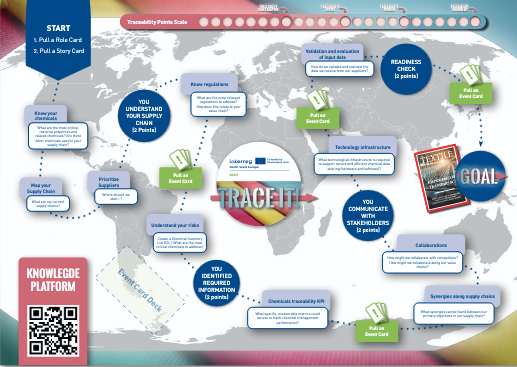
"Trace-It" is a simulation game that allows players to step into the shoes of departments of organisations aiming to implement chemcials traceability. Throughout the game play, players will be confronted with various challenges that need to be solved as a team. The game can be played in workshops with representatives from different organisations (incl. industry, NGO and public sector) or inside one company.
Access to the Manual of the Trace-IT Game
-
This paper reports on the insights and concepts generated during a policy workshop on 15th of October 2024 in Brussels. In this workshop representatives from textile and chemicals industry, NGOs, European Commission, European Parliament and Academia participated and contributed to this output.
January 2025
Access to the Policy workshop report
-
Featured in this book is the 'Why' and 'What' of DPP, and for the first time, presents fashion brands and retailers with a proposal and guidelines for the 'How'. As the 'responsible economic operators' for complying with DPP, brands and retailers can, and should, begin preparing for DPP now, and this book is their essential guide.
Rôles: #manufacturer, #distributor, #economic operator, #DPP service provider, #policymakers
Source: https://trustrace.com/hubfs/TrusTrace-Unlocking-DPP.pdf
-
The present report proposes a method for the definition and tracking of substances of concern in products (as defined in Article 2(27) of the ESPR) as well as for the assessment and preparation of potential restriction measures for substances impacting the product aspects listed in Article 5(1) of the ESPR. The method informs the setting of performance requirements and information requirements, when relevant for the product under study. The intended audience for this report is primarily members of teams who will be undertaking Preparatory Studies for ESPR product groups, including from the European Commission, as well as stakeholders.
Rôles: #manufacturer, #economic operator, #distributor
November 2025
Source: https://publications.jrc.ec.europa.eu/repository/handle/JRC143683
-
This report presents a practical, step-by-step methodology to define a proposal of which data should be included in Digital Product Passports (DPPs) under the Ecodesign for Sustainable Products Regulation (ESPR), and why it should be included. It complements and extends existing ESPR methodological work by focusing on the semantic definition and prioritisation of DPP information requirements within the specific context of the DPP, while also systematically investigating current industry data collection and data-sharing practices across product value chains. The methodology translates policy objectives and use cases into structured data needs, distinguishing essential, strongly recommended and voluntary elements through a transparent value–effort and feasibility assessment grounded in real-world practices.
Rôles: #DPP service provider
March 2026
Source: https://publications.jrc.ec.europa.eu/repository/handle/JRC145830
-
Cirpass2 presents a proposal for a reference architecture for the EU DPP system. The proposal comes in two versions: 1) One proposal for the reference architecture of the DPP system; 2) One proposal for the simplest and lowest cost implementation of the EU DPP system, based only on well-established web technologies and services. Furthermore, a video presentation on the proposal is available.
Rôles: #manufacturer, #DPP service provider, #blockchain integrators, #distributor, #customer, #dealer
May 2025
Sources:
D4.1 Reference architecture: https://zenodo.org/records/15467720
The simplest DPP System Proposal – A thought experiment: https://zenodo.org/records/15367064
Video "CIRPASS-2 DPP system architecture (presentation by Huib van Nieuwenhuijze, TNO - October 3, 2025)": -
This report supports the implementation of ESPR by proposing a methodology to identify and rank improved design options for sustainable products. It expands existing approaches by considering system-level impacts and using tools such as life-cycle assessment and costing to evaluate environmental, economic, and societal performance.
Rôles: #Manufacturer, #Economic operator, #Distributor
December 2025
-
The present report proposes a method for the definition and tracking of substances of concern in products (as defined in Article 2(27) of the ESPR) as well as for the assessment and preparation of potential restriction measures for substances impacting the product aspects listed in Article 5(1) of the ESPR. The method informs the setting of performance requirements and information requirements, when relevant for the product under study. The intended audience for this report is primarily members of teams who will be undertaking Preparatory Studies for ESPR product groups, including from the European Commission, as well as stakeholders.
Rôles: #Manufacturer, #Economic operator, #Distributor
November 2025
Source: https://publications.jrc.ec.europa.eu/repository/handle/JRC143683
-
This academic article reviews existing research on the Digital Product Passport (DPP) in the textile industry, analysing how it can support traceability, lifecycle data sharing, and circular economy practices
2025
-
This research article analyses the Digital Product Passport (DPP) as a tool to improve circularity and sustainability in manufacturing, providing structured product lifecycle data to increase supply-chain transparency and resource efficiency
2024
-
This research article analyses data requirements for Digital Product Passports (DPPs) to support decision-making across the product lifecycle in circular supply chains.
Through case studies and surveys with manufacturers and supply-chain actors, it identifies key data categories (e.g., product materials, maintenance, environmental data, logistics, and compliance) needed to enable reuse, repair, and recycling
2023
Source: https://www.sciencedirect.com/science/article/pii/S2352550923000441
-
This article studies the value ecosystem of Digital Product Passports (DPPs) and models how different stakeholders (manufacturers, suppliers, consumers, regulators, recyclers) exchange data and value through DPP systems.
Using literature review and real DPP examples (e.g., the EU battery passport), it proposes an e³-value model showing how DPPs can improve transparency, regulatory compliance, and circular-economy practices
2025
Source: https://onlinelibrary.wiley.com/doi/full/10.1111/jiec.13621?msockid=0f5dc9398fce6fd10317dc578eb76e8e
-