
A-1. Legislation overview
Section outline
-
-
Dr. Ioannis Dosis (German Environmental Agency) gives an overview of the regulatory landscape regarding chemical management, traceability and other related issues on EU level.
-
Alexandra Caterbow (HEJ Support) gives an overview of the regulatory landscape regarding chemical management, traceability and other related issues on global level.
-
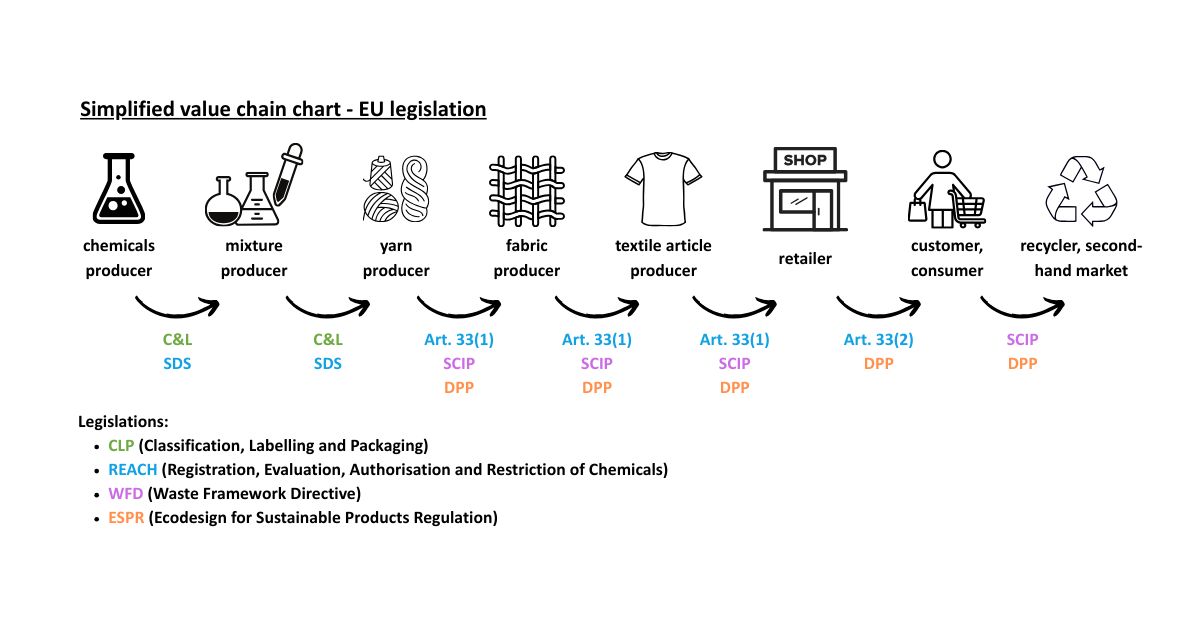
The simplified value chain chart shows some of the legal obligations of different actors in the value chain under the CLP (green), REACH (blue), WFD (pink) and ESPR (orange) regulations. Further information on these regulations can be found in the next sections, including information on the C&L inventory (C&L), safety data sheets (SDS), requirements for candidate list substances in articles (Art. 33), the SCIP database (SCIP) and the digital product passport (DPP). Detailed guidance documents on these legislations can be found in chapter A-2. (To know more on Legislation).
-
-
-
Click to explore a timeline representing a decade of regulations for chemical traceability requirements for textiles.
-
-
A. Introduction
The key elements of the REACH-Regulation (Regulation (EC) 1907/2006) are the registration, evaluation, authorisation and restriction of chemical substances. The Regulation is directly applicable in the Member States of the European Union since it entered into force on 1 June 2007.
Aim
REACH has the aim “to ensure a high level of protection of human health and the environment, including the promotion of alternative methods for assessment of hazards of substances, as well as the free circulation of substances on the internal market while enhancing competitiveness and innovation” (Article 1(1)).
Principle
The REACH Regulation is founded on the principle that manufacturers, importers, and downstream users are responsible for ensuring that the substances they produce, market, or use do not pose a risk to human health or the environment. This regulatory framework is guided by the precautionary principle.
Accordingly, the “no data, no market” rule applies, meaning that a substance can only be manufactured or placed on the market if the necessary data for its registration have been generated. Substances of Very High Concern (SVHCs) are to be gradually replaced with suitable alternatives or technologies, provided these are economically and technically feasible. Substances fulfilling the conditions listed under Article 57 of the REACH regulation can be defined as SVHC in accordance with the procedure laid down in Article 58. SVHCs are listed in ECHA’s Candidate List on ECHA CHEM.
The implementation of the technical, scientific and administrative aspects of REACH is undertaken by the European Chemicals Agency (ECHA) in Helsinki.
Processes under REACH
- Registration of all substances above one tonne per annum by the manufacturer or importer.
- Evaluation of selected registration dossiers and substances by ECHA and Member States.
- Identification and authorisation of Substances of Very High Concern.
- Restriction of the manufacture, use or placing on the market of certain hazardous substances, mixtures or articles.
Areas of application
REACH covers the manufacture, marketing and use of chemical substances whether they are used on their own (e.g., methanol or sodium hydroxide), in mixtures (e.g., paints), or incorporated into articles (e.g., textiles, tires, etc.).
Exceptions of the application are listed in Article 2 of the regulation.
Role under REACH
Under REACH you can have specific obligations for each individual substance you manufacture, import or use. Your obligations depend on your role in the supply chain (manufacturer, importer, distributor, user of chemicals…) for the specific substance.Even for mixtures or articles, most of the REACH obligations relate to the substances that are contained in them.
If your substance or mixture is classified as hazardous, you will also need to comply with CLP provisions.
Visit ECHA’s website to assess your role and obligations in the supply chain and to access all information related to guidance.
In this section, we will focus on the safety data sheet (SDS) and Article 33 of REACH that were mentioned in the simplified supply chain chart for EU legislation. Detailed guidance documents on the registration, evaluation, authorisation and restriction of chemical substances can be found on ECHA's website.
B. Some definitions
Article 3 of the REACH regulation provides definitions for terms that are essential to the regulation. Here we present the REACH definitions for ‘substance’, ‘mixture’ and ‘article’.
- ‘Substance: means a chemical element and its compounds in the natural state or obtained by any manufacturing process, including any additive necessary to preserve its stability and any impurity deriving from the process used, but excluding any solvent which may be separated without affecting the stability of the substance or changing its composition.’
- ‘Mixture: means a mixture or solution composed of two or more substances.’
- ‘Article: means an object which during production is given a special shape, surface or design which determines its function to a greater degree than does its chemical composition.’ This definition applies to almost all solid products such as textiles, furniture, shoes, sports equipment, toys or electronic devices and to each individual component of an assembled article, if this component comes under the REACH article definition.
C. Safety Data Sheet (SDS)
Safety Data Sheets (SDS) play a critical role in sharing information throughout the supply chain, including end users such as professional workers. They ensure that manufacturers and importers provide the necessary details to promote the safe use of substances and mixtures at every stage of their life cycle.
In addition to SDS, product labels serve as a key source of hazard information accessible to users, including both workers and consumers. Together, these tools help ensure that chemical risks are clearly communicated and understood.
A SDS includes comprehensive information such as the substance's properties, associated hazards, safe handling instructions, disposal methods and transport guidelines. It also outlines appropriate conditions for use and risk management measures to ensure both human health and the environment.
Regulatory provisions
A SDS is mandatory (Article 31(1)) when:
- a substance or mixture fulfils the classification criteria as a dangerous product according to the CLP Regulation, or;
- a substance is persistent, bio-accumulative and toxic, or very persistent and very bio-accumulative, according to the criteria in Annex XIII REACH, or;
- a substance is included in the list of substances that are candidates for Authorisation (SVHC) which could possibly be subjected to Authorisation in the future according to Article 59(1) REACH.
A SDS is not required:
- in the case of articles,
- for hazardous substances and mixtures made available to the general public (Article 31(4)), if the information for a safe use of the substances or a mixture is sufficient.
A SDS must be supplied on request (Article 31(3)) for certain mixtures that are not classified but contain at least one substance:
- that presents a danger for health or the environment, in an individual concentration of ≥ 1 % by weight for non-gaseous mixtures and ≥ 0.2 % by volume for gaseous mixtures;
- being PBT (persistent, bioaccumulative and toxic), vPvB (very persistent, bioaccumulative and toxic), or SVHC in an individual concentration ≥ 0.1 % by weight for non-gaseous mixtures;
- having an EU workplace exposure limit.
SDS are to be provided free of charge on paper, or in electronic format (Article 31(8)) and in the official language of the Member State in which the substance is being placed on the market (Article 31(5)). Information on the required languages of the SDS for each Member State is accessible in a document made available on ECHA’s website.
Update obligations
SDS must be updated (Article 31(9)):
- as soon as new information which can affect the management of risks or new information regarding hazards are made available;
- once an authorisation (under REACH) is granted or denied;
- as soon as a restriction (under REACH) has been adopted.
In addition, it is recommended to regularly review and update a SDS.
The updated SDS is disseminated free of charge to all the former recipients for whom the providers have supplied the substance or mixture within the last 12 months.
SDS content
The content of a SDS is defined in Annex II REACH and is divided into 16 sections.
The Guidance on the compilation of safety data sheets, which is available on ECHA’s Website, supplies the practical details on data that must be included in each section of a SDS.
D. Requirements for Candidate List substances in articles
To ensure a high level of protection from the use of substances with serious effects on human health or the environment, their presence in articles and any relevant information on safe use need to be laid open and communicated in the supply chain, as this is a prerequisite for the identification and application of appropriate risk management measures. It also empowers both operators and consumers to make informed purchasing decisions. Detailed information can be found in ECHA’s Guidance on requirements for substances in articles.
Candidate list substances
Substances meeting one or more criteria defined in Article 57 of REACH can be identified as Substances of Very High Concern (SVHC) and placed on the Candidate List for authorisation. These substances include:
- CMR substances (carcinogenic, mutagenic or reprotoxic, category 1A or 1B),
- PBT or vPvB substances (persistent, bioaccumulative and toxic / very persistent and very bioaccumulative),
- Substances with equivalent levels of concern (e.g. endocrine disruptors).
The Candidate List is regularly updated by ECHA. Companies are advised to monitor ECHA's Public Activities Coordination Tool (PACT) to anticipate future listings and prepare for compliance obligations in advance.
Communication of Candidate List Substances in Articles (Article 33)
According to Article 33, any supplier of an article must provide relevant safety information to the recipient of the article or, upon request, to a consumer when the following two conditions are met:
- The substance is included in the Candidate List for authorisation, and
- The substance is present in the article at a concentration above 0.1% weight by weight (w/w).
Regarding the obligations to communicate information on substances in articles (both to recipients and consumers), please note the following:
- Information must be provided to professional users and distributors the first time an article is supplied after a substance has been added to the Candidate List. For consumers, this information must be provided upon request, within 45 calendar days of the request and free of charge.
- At minimum, the name of the substance must always be communicated, even if no additional safety information is deemed necessary.
- The 0.1% w/w threshold applies to each individual article, including articles that form part of a complex object (a product made up of more than one article).
- There is no tonnage threshold that triggers these communication obligations.
- A distributor cannot simply refer consumers to their own supplier – they must provide the information themselves.
- Obligations apply regardless of whether the supplier is aware of the substance's presence; it is therefore in the supplier's interest to proactively seek such information.
Suppliers must communicate information sufficient to allow the safe use of articles containing Candidate List substances (>0.1% w/w). This means considering all foreseeable life-cycle stages including processing, (re)packaging, end use, recycling, and disposal.
Information on safe use should cover:
- Use conditions (e.g. temperature, frequency, duration, indoor/outdoor)
- Risk management measures to reduce exposure and emission
The appropriate level of detail varies depending on the recipient (industrial user vs. consumer). For complex objects, communication obligations apply to each constituent article containing a Candidate List substance above the threshold. REACH does not prescribe a specific format; possible formats include modified instructions for use, labels, standard industry communication formats, or IT systems.
Notification of Candidate List substances in articles (Article 7(2))
Notification of a substance in articles is required from producers and importers of articles when all the following conditions of Article 7(2) are met:
- The substance is included in the Candidate List for authorisation.
- The substance is present in articles produced and/or imported above a concentration of 0.1% (w/w).
- The total amount of the substance present in all articles produced and/or imported, which contain more than 0.1% (w/w) of the substance, exceeds 1 tonne per actor per year.
- Exemptions do not apply.
Notifications must be submitted no later than 6 months after the substance is added to the Candidate List, and must include:
- Identity and contact details of the producer/importer,
- Registration number of the substance (if available),
- Identity and classification of the SVHC (available from the Candidate List),
- A brief description of the substance's use in the article(s) and the article's use,
- The tonnage range of the substance in articles (1–10 t, 10–100 t, 100–1,000 t, or ≥1,000 t).
More detailed information is given on how to provide this information within the notification in the Manual - How to prepare a substance in articles notification. Notifiers are strongly encouraged - though not legally required - to keep their notifications up to date if the notified information changes (e.g. tonnage range or new articles).
-
This document lists textile specific restrictions of substances that are listed in Annex XVII of the REACH regulation. We want to inform you that this list may not be complete and that the official REACH regulation is the only legally binding document. Furthermore, this document list ECHA guideline documents on specific restriction entries as well as ECHA Q&A's related to textile specific REACH restrictions.
September 2026
Source: own ECHT research
-
A. Introduction
CLP (Regulation (EC) 1272/2008) is the acronym for Classification, Labelling and Packaging of substances and mixtures. This Regulation entered into force on the 20th of January 2009 and is based on the Globally Harmonized System (GHS), a set of recommendations drafted by the United Nations.
Aim
The purpose of the CLP regulation is to clearly communicate chemical hazards to workers and consumers across the European Union by classifying and labelling chemicals appropriately.
The primary goal of CLP is to protect human health and the environment. All parties involved in the supply chain are responsible for complying with the classification, labelling and packaging rules. Before chemical products enter the market, manufacturers and suppliers must assess the potential risks these substances and mixtures pose to people and the environment and classify them based on their identified hazards. Hazardous chemicals must be labelled using a standardised system to ensure that workers and consumers understand the risks before use.
Moreover, CLP is closely connected with:
- REACH, especially in relation to safety data sheets;
- Various other European regulations, including those on Biocides, Plant Protection Products, major industrial accident prevention (Seveso Directive), and workplace chemical safety (Carcinogens and Mutagens Directive, Chemicals Agents Directive).
Scope
CLP requirements apply to chemical substances (such as chloric acid, ethanol, iron, cooking salt, ammonia, bleach...) as well as to mixtures (detergents, paints, lacquers, concrete, oil...).
The CLP Regulation does not apply to certain categories such as radioactive substances, waste, non-isolated intermediates, substances under customs supervision, and materials used for scientific research and development. It also excludes finished products intended for end users, including medicinal and veterinary products, cosmetics, medical devices, and food or animal feed products regulated under other EU legislation.
In this section we will mainly focus on the C&L inventory. Visit ECHA’s webpage for further information and guidance on the CLP regulation.
Classification
All substances which are placed on the EU market must be classified by manufacturers, importers or downstream users of chemical substances or mixtures according to Article 4.1 CLP. This obligation applies regardless of the tonnage manufactured, imported or placed on the market.
Besides the obligation to classify under the CLP Regulation, manufacturers and importers must also classify all substances subject to registration and notification obligations under the REACH Regulation (Articles 6, 7, 9, 17 and 18 REACH).
There are two types of classification:
- Harmonised classification: This type of classification concerns substances for which a classification has been decided upon at the European level. When a harmonised classification and labelling exist, companies must apply this classification. Harmonised classifications can be found in the tables of Annex VI CLP. A harmonised classification only applies to substances and not to mixtures.
- Self-classification: This type of classification is required when substances do not have a harmonised classification or where a harmonised classification only covers certain hazard classes. The self-classification has to be done by: manufacturers of substances, importers of substances or mixtures and downstream users, including formulators.
Further detailed information and guidance can be found ECHA’s webpage on classification.
Labelling
The label is the main source of information on the hazards of chemicals that can be accessed by users who may be workers but also consumers. Labelling ensures that the characteristics of a given product are clearly visible and accessible. These labels help the user to be aware of any specific hazards as well as necessary precautions which need to be taken when using a product.
Suppliers or importers of a substance or mixture are required to label the product if this product is classified as hazardous. In addition, if a mixture contains at least one substance that is classified as hazardous, the product must be labelled as well.
According to Article 17 CLP, a substance or a mixture classified as hazardous must bear a label including the following elements:
- Name, address, and telephone number of the supplier(s);
- The nominal quantity of the substance or mixture in the package where this is being made available to the general public, unless this quantity is specified elsewhere on the package;
- Product identifiers;
- Hazard pictograms, where applicable;
- The relevant signal word, where applicable;
- Hazard statements, where applicable;
- Appropriate precautionary statements, where applicable;
- A section for supplemental information, where applicable.
Further detailed information and guidance can be found on ECHA’s webpage on labelling.
B. Classification and labelling (C&L) inventory
The Classification and Labelling (C&L) inventory is a database maintained by ECHA that contains information on the classification and labelling of substances placed on the European market. It includes data on both notified and registered substances, as well as the list of harmonised classifications and labelling specified in Annex VI of the CLP Regulation.
C&L notification
Within the framework of the C&L inventory, manufacturers and importers are required to notify the classification of all substances placed on the market.
A notification to ECHA must be submitted when:
- substances are manufactured and/or imported and are subject to registration under the REACH Regulation;
- substances are classified as hazardous;
- mixtures contain a hazardous substance present above the relevant concentration limit, causing the mixture itself to be classified as hazardous;
- articles contain a substance that is subject to registration according to Article 7 of the REACH Regulation.
The notification must be made within one month of placing the substance on the market. For importers, this one-month period begins from the date the substance, either on its own or within a mixture, is physically brought into the territory of the European Union.
Note:
- There are no exemptions from C&L notification requirements. Therefore, even substances exempt under the REACH Regulation must be notified.
- If a manufacturer or importer has already submitted a registration dossier under REACH for a substance, a separate C&L notification is not required since the necessary classification and labelling information is already included in the registration dossier.
How to notify
C&L notifications must be submitted electronically through the REACH-IT portal on the ECHA website. There are three submission methods available:
- Directly online using REACH-IT;
- Creating an IUCLID dossier and submitting the notification via REACH-IT;
- Uploading a bulk notification as an XML file through REACH-IT.
Information in the C&L inventory
The following information is published according to CLP (Article 42):
- The name in the IUPAC nomenclature for substances classified with certain hazard classes or categories set out in Article 119(1)(a), without prejudice to Article 119(2)(f) and (g) of REACH;
- The name of the substance as given in EINECS, if applicable, and other numerical identifiers as appropriate and available;
- The classification and labelling of the substance.
All notifications for any published substance are included in the C&L Inventory and this includes notifications for non-classified substances.
More information and guidance concerning C&L notifications can be found on ECHA’s website.
-
The Ecodesign for Sustainable Product Regulation (ESPR) is an initiative, consisting of a package of measures. It entered into force in July 2024. The ESPR provides concrete regulatory measures that help achieve the Green Deal’s circular economy goals, translating its broad goals into specific product requirements to ensure that the EU market shifts toward sustainable production and pushing manufacturers to adopt sustainable practices. Furthermore, the ESPR sets binding conditions that textile products must meet to enter the EU market. The new requirements will be defined under specific delegated acts for product groups, such as textiles, electronics or furniture. The delegated acts will detail the new requirements for the products, in terms of design, durability, reparability, recyclability, etc.
As the ECHT project focuses on tracing back which chemicals are present in an article, we focus here on the definition of substances of concern (SoC) under the ESPR. Furthermore, we provide a short overview of ecodesign requirements and the Digital Product Passport (DPP), a central measure under the ESPR.
A. Roles and responsibilities of economic operators
Different roles exist under the ESPR regulation, which are defined in Article 2. Here, we will briefly describe obligations that apply to some economic operators. All obligations of these economic operators are detailed in chapter VII of the regulation. Economic operators must define their role in order to comply with their obligations under the ESPR.
Economic operator
Definition
Indicative responsibilities under the ESPR
Any natural or legal person that manufactures a product or that has a product designed or manufactured and markets that product under their name or trademark.
Ensures that the product complies with all applicable ecodesign requirements before being placed on the market or put into service (Chapter II). Ensures that required documentation and information obligations are fulfilled (Art. 7). Where a DPP is required under a product-specific delegated act, ensures compliance with DPP obligations defined in the relevant product-specific delegated act (Art. 9).
Importer
Any natural or legal person established in the Union that places a product from a third country on the Union market.
Ensures that products placed on the Union market comply with applicable ESPR requirements. Where the manufacturer is not established in the Union, assumes manufacturer-equivalent obligations, including those related to information requirements and the DPP, as defined in the Regulation and relevant delegated acts.
Authorised representative
Any natural or legal person established in the Union that has received a written mandate from the manufacturer to act on the manufacturer’s behalf in relation to specified tasks with regard to the manufacturer’s obligations under this Regulation.
Performs specific tasks on behalf of the manufacturer within the limits of the mandate. Does not assume overall responsibility for product compliance unless explicitly provided for in the Regulation.
Distributor
Any natural or legal person in the supply chain, other than the manufacturer or the importer, that makes a product available on the market.
Verifies that required information and identifiers are present before making a product available on the market, including the presence of access to a DPP where required by a delegated act. Refrains from making products available if they know, or have reason to believe, that the product does not comply with applicable ESPR requirements.
Dealer
A distributor or any other natural or legal person that offers products for sale, hire or hire purchase, or that displays products, to end users in the course of a commercial activity, including through distance selling; and includes any natural or legal person that puts a product into service in the course of a commercial activity.
Verifies that required information and identifiers are present before making a product available on the market, including the presence of access to a DPP where required by a delegated act.
B. Substances of concern (SoC)
Recital 31 of the ESPR states that “Information on the presence of substances of concern in products is a key element to identify and promote products that are sustainable. The chemical composition of products largely determines their functionalities and impacts, as well as the possibility for their reuse or for recovery once they become waste”. Furthermore, information about substances of concern will need to be disclosed in the Digital Product Passport (see Article 7(5) and next section).
Article 2(27) of the ESPR defines a substance of concern as a substance that:
(a) meets the criteria laid down in Article 57 of Regulation (EC) No 1907/2006 and is identified in accordance with Article 59(1) of that Regulation;
(b) is classified in Part 3 of Annex VI to Regulation (EC) No 1272/2008 in one of the following hazard classes or hazard categories:
(i) carcinogenicity categories 1 and 2;
(ii) germ cell mutagenicity categories 1 and 2;
(iii) reproductive toxicity categories 1 and 2;
(iv) endocrine disruption for human health categories 1 and 2;
(v) endocrine disruption for the environment categories 1 and 2;
(vi) persistent, mobile and toxic or very persistent, very mobile properties;
(vii) persistent, bioaccumulative and toxic or very persistent, very bioaccumulative properties;
(viii) respiratory sensitisation category 1;
(ix) skin sensitisation category 1;
(x) hazardous to the aquatic environment — categories chronic 1 to 4;
(xi) hazardous to the ozone layer;
(xii) specific target organ toxicity — repeated exposure categories 1 and 2;
(xiii) specific target organ toxicity — single exposure categories 1 and 2;
(c) is regulated under Regulation (EU) 2019/1021; or
(d) negatively affects the reuse and recycling of materials in the product in which it is present;
The Candidate List mentioned under (a), the CLP Annex VI – harmonised classifications mentioned under (b) and the list of substances subject to POPs Regulation mentioned under (c) can also be found on ECHA CHEM.
C. Overview on ecodesign requirements
Recital 3 of the ESPR states that “a fully functioning internal market for sustainable products is a pre-requisite for the establishment of a circular economy in the Union. Common ecodesign requirements at Union level would enable the development, deployment and scaling-up of new circular economy business models throughout the internal market”.
Further, recital 16 declares that “ecodesign requirements should include, as appropriate, performance requirements or information requirements, or both. Those requirements should be used to improve product aspects relevant for environmental sustainability, such as durability, reusability, repairability, energy efficiency, recyclability, and carbon and environmental footprints”.
This section focuses briefly on the ecodesign requirements with a specific focus on substances and substances of concern. Detailed information on ecodesign requirements can be found in Chapter II of the ESPR regulation.
Ecodesign requirements (Article 5)
Article 5 sets out what the ecodesign requirements for products must aim to improve. The requirements themselves are set product group by product group in delegated acts adopted under Article 4. They are based on the product parameters in Annex I.
The aspects to be improved include durability, reliability, repairability, recycled content, recyclability, energy and resource use, carbon footprint, and expected waste. One of them is "the presence of substances of concern" (Article 5(1)(g)). The aspects apply only where they are relevant to the product group concerned.
Under Article 5(14), the Commission must determine, where relevant, which substances meet the definition in Article 2(27)(d). In doing so, it must consider whether a substance:
- makes reuse or recycling more complicated, costly, environmentally harmful, or more demanding in energy or resources;
- impairs the technical properties, functionality, usefulness, or value of the recycled material;
- negatively affects the look or smell of the recycled material.
Performance requirements (Article 6)
Article 6 says products must meet performance requirements. These are set product group by product group in delegated acts adopted under Article 4 (Art. 6(1)). They are based on the product parameters in Annex I and can take two forms (Art. 6(2)):
- quantitative: minimum or maximum levels for a parameter, such as a limit on a value;
- non-quantitative: requirements that aim to improve performance without a fixed number.
Article 6(3) covers performance requirements based on Annex I, point (f), which the text links to the presence of substances in products. It precises that these requirements must not restrict the presence of substances in products for reasons relating primarily to chemical safety. However, these requirements shall reduce significant risks to human health or the environment.
Information requirements (Article 7)
Products must comply with information requirements set product group by product group in delegated acts adopted under Article 4 (Art. 7(1)).
At a minimum, these requirements must cover (Article 7(2)(a)) requirements related to substances of concern set out in Artice 7(5) and requirements related to the digital product passport set out in Chapter III. Digital product passports should be made available as precised in Article 7(7). Further information on these points will be discussed in the next section specific to DPPs.
Where appropriate, products may also have to come with extra information (Art. 7(2)(b)). Examples are performance scores (repairability, durability, carbon or environmental footprint), instructions on use, repair and end-of-life handling, as well as information for treatment facilities on disassembly, reuse and recycling.
Where a digital product passport is available, the required information shall be provided therein and shall, where necessary, also be provided in one or more of the following forms (Art. 7(7)):
- on the product itself,
- on its packaging,
- on a label under Article 16,
- in a user manual or other documentation accompanying the product,
- on a free-access website or application.
The information shall be provided in a language which can be easily understood by customers, as determined by the Member State on whose market the product is to be made available or in which it is to be put into service (Art. 7(8)).
D. Overview of the Digital Product Passport
A new measure featured in the ESPR is the implementation of a Digital Product Passport (DPP). The DPP aims to electronically register, process and share information amongst the supply chain actors, authorities and consumers. It is defined by the European Commission as a structured collection of product related data with pre-defined scope and agreed data ownership and access rights conveyed through a unique identifier, and that is accessible via electronic means through a data carrier.
According to Article 9(3) of the ESPR, the DPP “should”:
(a) ensure that actors along the value chain, in particular consumers, economic operators and competent national authorities, can access product information relevant to them;
(b) facilitate the verification of product compliance by competent national authorities; and
(c) improve traceability of products along the value chain.
DPP datasets will include both mandatory information and, optionally, additional voluntary data provided by manufacturers. Regulatory information about the DPP can be found in the ESPR regulation. A delegated act on textiles and footwear, which will define detailed DPP requirements for textile products, is expected to be published in 2027. Further information can be found in a report named « Methodology for defining data requirements for the Digital Product Passport under the ESPR framework » by the Joint Research Centre. Information from this report were used for the following contents of this section.
D.1 Roles and responsibilities of economic operators
Under the ESPR, compliance with product-specific ecodesign requirements - including information obligations implemented through the DPP - is ensured by assigning obligations to economic operators according to their respective roles in the supply chain, as defined in the Regulation (Article 2). Consistent with the standard distribution of responsibilities under EU product legislation, primary responsibility rests with the manufacturer or, where the manufacturer is not established in the Union, with the importer.
- The ESPR assigns primary responsibility for compliance with Digital Product Passport requirements to the manufacturer, meaning that the entity designing and placing the product on the EU market must ensure that all required data is complete, accurate, and compliant before the product is sold.
- The importer assumes equivalent responsibility to the manufacturer when products are produced outside the EU, ensuring that imported goods meet all ESPR and DPP obligations.
- Authorised representatives may carry out specific delegated tasks, such as documentation handling or communication with authorities, but they do not assume full legal responsibility unless explicitly defined.
- Distributors have a verification and due-care obligation, which means they must check that required information, including access to a DPP, is present and must not place non-compliant products on the market.
- Other actors, such as online marketplaces or fulfilment service providers, have role-specific facilitation responsibilities, but they do not bear primary responsibility for the content of the DPP.
D.2 DPP content requirements
The ESPR defines several categories of information that may be required to be made available through the DPP.
D.2.1 Product and producer identification (Annex III b)-d), g)-k))
The DPP should include:
- unique identifiers, such as a unique product identifier (UPI), a unique operator identifier (UOI), and where relevant a unique facility identifier (UFI), which together enable consistent identification, traceability, and linking of data across systems
- descriptive product and producer information, including the product name, model, version, and the identity and contact details of the responsible economic operator, ensuring that the product can be clearly distinguished and attributed
D.2.2 Product-specific parameters and information (Article 7(2)(b))
The ESPR establishes the legal framework for setting product-specific information requirements, which can be delivered through the DPP by means of delegated acts tailored to particular products. Specifically, Article 7(2)(b) empowers these delegated acts to mandate the inclusion of certain categories of information, where appropriate for the relevant product group:
- product-specific parameters related to sustainability and circularity (referred to in Annex I), such as durability, reparability, recyclability, and energy or resource efficiency, depending on the requirements defined in product-specific delegated acts
- information for installation, use, maintenance, and repair, enabling users and professionals to handle the product correctly and extend its lifetime
- information for treatment facilities, such as disassembly instructions or material composition, to support reuse, refurbishment, and high-quality recycling
- additional information influencing sustainable product choices and handling, supporting broader environmental and circular economy objectives
D.2.3 Information on substances of concern (Article 7(5))
Under ESPR Article 7(5), the following minimum information must be tracked for each SoC in the DPP:
- The name or numerical code of the SoC present in the product;
- The location of the SoC within the product;
- The concentration, maximum concentration or concentration range of the SoCs, at the level of the product, its relevant components, or spare parts;
- Relevant instructions for the safe use of the product;
- Information relevant for disassembly, preparation for reuse, reuse, recycling and the environmentally sound management of the product at the end of its life.
Delegated acts may, where appropriate and proportionate, mandate the disclosure of information including:
- the identification of substances of concern (SoC) contained in the product;
- details regarding their presence or location within the product, where needed to support safe use, repair, refurbishment, or end-of-life treatment; and
- information relevant to treatment operators, including recyclers, to facilitate proper handling or separation.
Exemptions from tracking obligations may apply under Article 7(6)(b). Grounds for exemption include the technical feasibility or relevance of tracking substances of concern, the existence of analytical methods to detect and quantify them and the need to protect confidential business information or in other duly justified cases.
D.2.4 Information required under other Union law (Annex III a), e), f))
- The DPP may integrate information already required under other EU legislation, such as compliance documentation, declarations of conformity, or technical files, thereby avoiding duplication of reporting obligations.
- The DPP may also include user-facing information, such as manuals, safety instructions, or warnings, which are already required under existing legal frameworks.
D.3 Non-functional requirements (how data must be provided)
The ESPR also establishes a set of non-functional requirements, applying to the specifications and provision of DPP data. These requirements concern the qualities that DPP data must exhibit, not the content of information as such.
- Relevant actors along the value chain should easily access and understand the information made available (Article 9(3)(a)).
- The information provided through the DPP supports the verification of compliance with applicable product requirements (Article 9(3)(b)).
- The DPP contributes to improved traceability along the supply chain (Article 9(3)(c)).
- The data in the DPP is complete, accurate and kept up to date (Article 9(1)).
- The data must be provided in interoperable, structured, and machine-readable formats, based on open standards, so that it can be shared and reused across digital systems (Article 10(1)(d)).
- The data must remain available for a defined period, typically aligned with the product’s lifetime, supporting long-term uses such as repair, reuse, and market surveillance (Article 9(2)(i)).
D.4 DPP data system information (how the system operates)
DPP data system information (DSI) refers to system-level requirements that regulate the functioning of the DPP independently from the product-specific information content established in product-group delegated acts. These requirements relate to the operation of the DPP as a digital system, rather than to the specific information it includes.
D.4.1 Access rights and role-based data visibility (Art. 9(2)(f))
- The DPP should implement role-based access control, meaning that different categories of users, such as consumers, economic operators, and authorities, have access to different levels of information.
- This approach ensures a balance between transparency and the protection of confidential business information, allowing sensitive data to be restricted while still enabling regulatory oversight and informed decision-making.
D.4.2 Granularity levels of the DPP (Art. 9(2)(d))
- The DPP may be defined at different levels of granularity, such as product model, batch, or individual item level, depending on the needs for traceability and the characteristics of the product group.
- The chosen level of granularity must balance policy objectives with feasibility and cost, considering existing industry practices and avoiding unnecessary administrative burden.
D.4.3 Rules on governance (Art. 9(2)(g-h))
- The DPP should include clear rules on data governance, specifying which actors are responsible for creating, updating, and maintaining different data elements.
- The system must define update triggers, such as product placement on the market, repair, refurbishment, or end-of-life treatment, ensuring that data remains current throughout the product lifecycle.
- The DPP may include traceability mechanisms for changes, such as timestamps and update logs, to ensure accountability and support compliance verification.
D.4.4 DPP registry and web portals (Art. 13 and 14)
- The ESPR establishes a central EU DPP registry, where key identifiers and links to product passports are stored to ensure traceability and system integrity. A specific guide helps economic operators to use the DPP registry. The implementation arrangements for the DPP registry are laid down in the Commission Implementing Regulation (EU) 2026/1778.
- A web portal will provide user access to DPP information, enabling both public access to non-sensitive data and restricted access for authorised actors.
D.5 Data carrier (link between product and DPP)
- Each product must be associated with a data carrier, which provides a direct link to the Digital Product Passport.
- The data carrier must ensure a reliable and persistent connection between the physical product and its digital information.
- The data carrier must be visible, accessible, and durable, remaining functional throughout the relevant period of the product’s lifecycle.
- The ESPR does not prescribe a specific technology but requires alignment with standardised and interoperable solutions.
D.6 Harmonised standards for DPPs
The Commission Implementing Decision (EU) 2026/1736 of 14 July 2026 published references of harmonised standards for DPPs drafted in support of the ESPR regulation:
- EN 18216:2026 Digital product passport – Data exchange protocols
- EN 18219:2026 Digital product passport – Unique identifiers
- EN 18220:2026 Digital product passport – Data carriers
- EN18221:2026 Digital product passport – Data storage, archiving, and persistence
- EN 18222:2026 Digital Product Passport – Application Programming Interfaces (APIs) for product passport lifecycle management and searchability
-
This 32-question document is the most comprehensive official guidance available to date on how the DPP will work under the Ecodesign for Sustainable Products Regulation (ESPR) — Regulation (EU) 2024/1781. The FAQ targets every stakeholder involved in the DPP ecosystem. Manufacturers and importers will find clarity on their obligations to create, register and maintain passports before placing products on the EU market. SMEs can understand the specific support mechanisms foreseen under Article 22 of the ESPR, including free digital tools and mandatory national one-stop shops. Distributors and online marketplaces learn when and how they become responsible for DPP accessibility. Consumers get a clear picture of their rights to access product information — free of charge, anonymously, without a smartphone if needed. Repairers and recyclers discover how the DPP will unlock technical data that makes circular business models more viable. Customs and market surveillance authorities understand how the central DPP Registry will enable automated border checks and targeted enforcement.
May 2026
-
The European Commission has prepared a comprehensive Frequently Asked Questions (FAQ) document to provide preliminary clarifications on the new Ecodesign for Sustainable Products Regulation (ESPR). The FAQ document addresses a wide range of topics, from the scope of the regulation to specific product categories, the Digital Product Passport, the Ecodesign Forum and the timeline for implementation. It provides valuable insights into the ESPR's impact on various stakeholders, including manufacturers, importers, and consumers.
September 2024
-
The Waste Framework Directive establishes key concepts and definitions for waste management, including what constitutes waste, recycling, and recovery. It also sets out fundamental principles for how waste should be managed. These include ensuring that waste is handled:
- without posing a threat to human health or the environment
- without endangering water, air, soil, plants, or animals
- without creating nuisances such as noise or unpleasant odours
- and without negatively impacting the countryside or protected areas of interest
The targeted revision of the Waste Framework Directive (2025), which entered into force on 16 October 2025, has a specific focus on Extended Producer Responsability (EPR) schemes for textiles (Article 22). The Extended Producer Responsibility (EPR) for textiles mandates that manufacturers and brands are financially and operationally responsible for the entire lifecycle of their products, particularly for collection, sorting and recycling.
In this section, we further focus on the SCIP database, a database that collects information about hazardous substances in products placed on the EU market.
Overview of the SCIP database
The SCIP database, which stands for "Substances of Concern in articles as such or in complex objects (Products)" was established under the Waste Framework Directive to manage hazardous substances in products. Since 5 January 2021, companies placing articles on the EU market that contain substances of very high concern (SVHCs) from the Candidate List in concentrations above 0.1% weight by weight (w/w) are required to submit information about these articles to ECHA. This information is stored in the SCIP database, which ensures transparency about the presence of Candidate List substances throughout the entire lifecycle of products and materials - including at the waste stage. The database makes this information accessible to both waste operators and consumers.
Detailed information and guides on SCIP notifications can be found on ECHA’s website.